With backup response speed critical for AI datacentre resilience, Nyobolt needed a bidirectional power system which wouldn’t limit their ambitions.
 Artificial intelligence is revolutionising the modern world. Routine tasks are being automated, with personalised analysis of large datasets often possible in seconds. Typical uses include search engines and image generation. However, AI platforms are increasingly being used across many industries to lighten workload and streamline results.
All of the additional user functionality must come at a cost. AI datacentres drive much higher peak power demands at significantly faster rates than traditional IT loads. Demand is far more unpredictable over the course of a day. Events such as AI training create large current transients, which existing grid infrastructure was not designed for.
To alleviate demand, typically peak shaving systems use supercapacitors for short transients. Battery banks then provide hold-up power for longer events or grid loss.
Nyobolt use niobium‑based anode materials within their batteries. This allows for low impedance, long cycle life and rapid C‑rates when compared to existing technologies. For example, a 350kW supercar can be charged from 10% to 80% in under 5 minutes.
The company have developed the DRS (Dynamic Response System) for AI datacentres. A battery management system, cells and chargers are combined in one enclosure. The DRS responds in microseconds and catches transient spikes before they cause damage, replacing supercapacitors. The cells contain enough energy to also serve as back-up during low grid power.
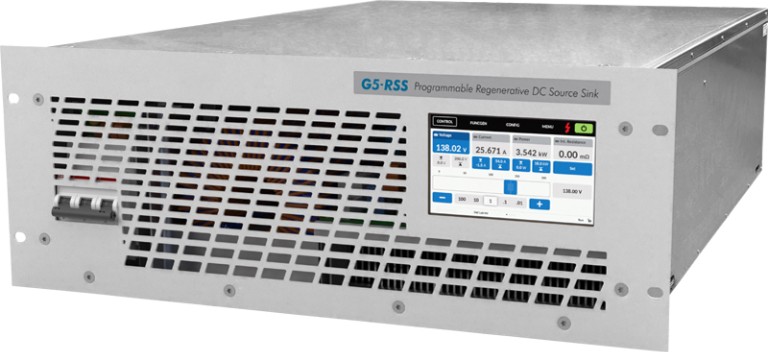
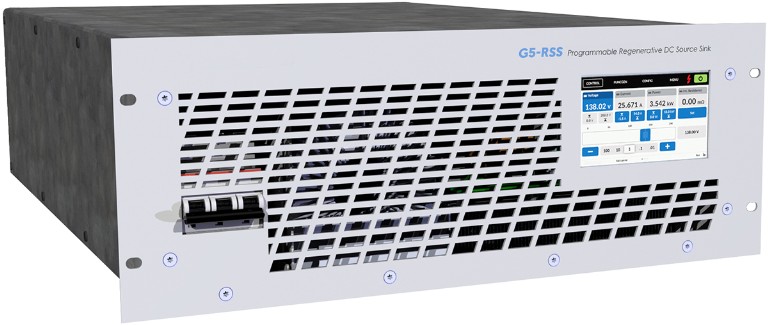
Nyobolt used the bidirectional G5-RSS power system during testing. Dan Collingwood, Test System Lead, stated “We are demanding discharge pulses well over 1000A at speeds of 100µs. The G5-RSS can keep up with the high C-rates and rapid slew rates of our batteries. It’s an order of magnitude faster than anything else on the market.”
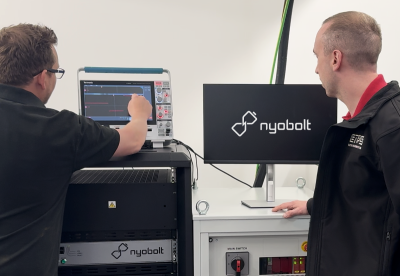 The G5-RSS features industry leading response speeds of <25μs for quadrant step changes. This allows Nyobolt to both test batteries under realistic conditions, as well as emulating their energy storage system. Back-to-back batteries were previously used to achieve the real world response times.
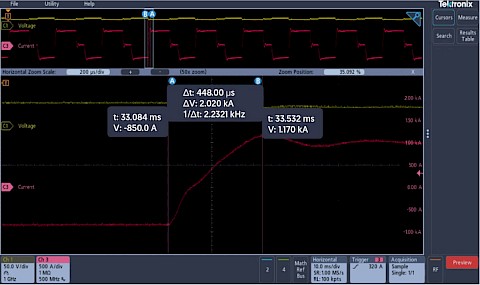 The example scope shot (left) shows a current step through quadrants during Nyobolt’s testing using the G5-RSS. The user adjusted the slope rate to perform a transition of 2020A in 448μs, as was required for their testing.