22nd September 2026

Aurora Interface for AC & DC P-HIL

Are you looking for a simple way to integrate a programmable power system into your P-HIL test bench? Do you require a PSU with the highest possible resolution and dynamics? Perhaps your application is at the cutting edge of research? Our AC and DC amplifiers have you covered...

A high-speed SFP (small form-factor pluggable) interface is available to order for selected AC and DC power systems. The interface uses the Aurora communication protocol to streamline integration into common P-HIL platforms. This includes Opal-RT, Typhoon, and Speedgoat. It is available for both new and existing units.

The interface transmits digital data via SFP standards, using optical cables between the amplifier and P-HIL system. It provides more functionality and faster data transfer when compared with analogue interfaces. It also eliminates the need for electrical shielding of comms.

The interface is available for selected AC & DC systems including:

  EAC-ACS-4Q G5-RSS
Nominal Power From 30kVA up to 2.5MVA From 9kW up to 6MW
Voltage Range 0 to 528VRMS line to line (higher voltages on request) From 0 to 60VDC up to 0 to 3000VDC*
Current Range From 3× 0 to ±43A
up to 3× 0 to ±3.6kA
From 0 to ±54A
up to 0 to ±121kA
Fundamental
Frequency
16 to 1000Hz DC
Modulation Bandwidth 5kHz 10kHz
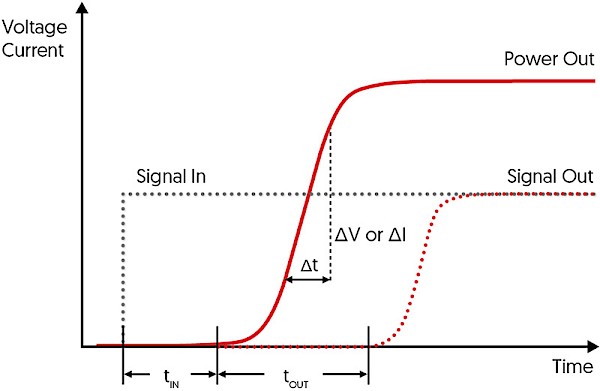
tIN 42μs 45µs
tOUT 34μs 42µs
ΔV/Δt 10–90% FS 100μs 170µs
ΔI/Δt 10–90% FS 180μs 20µs

* Voltages greater than 1500V possible with a midpoint earth

Application Examples

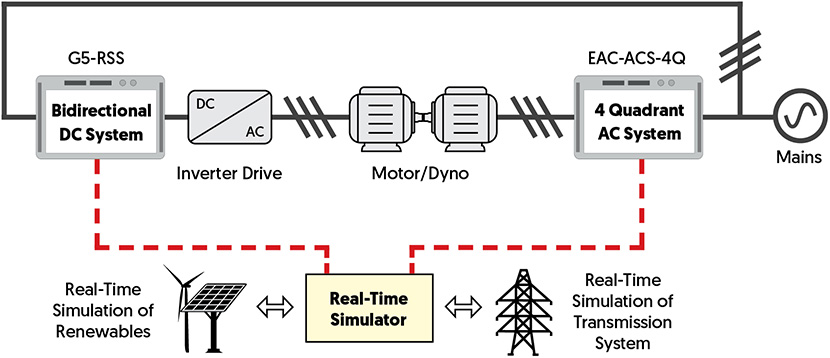
The versatility of our programmable AC and DC amplifiers means that they are well adopted across many different industries and test applications. Some common P-HIL integration examples include:

  • Battery Emulation: Replication of electrical characteristics when testing battery powered devices. Increases repeatability and saves operators’ time conditioning control variables of a real energy storage device for each test, such as state of charge and temperature.
  • Smart Grid Test Setup: Real-time simulation of complex network scenarios. Impacts of energy sources and conversion systems such as photovoltaics, fuel cells, capacitors, batteries and electrolysers can be investigated.
  • DC Distribution Grids: Simulation of dynamic DC loads for stability testing of complex networks on large ships, aircrafts, and stationary systems. Multi-module G5-RSS DC systems based around a midpoint earth are possible, recreating a +/- voltage output commonly found in large marine and aerospace installations.
  • Inverter Testing: Stability and power testing by implementing different input and output variables under real-time conditions.
  • Drivetrain Emulation: The high dynamics of the G5-RSS DC amplifiers allow power characteristics of a high performance drivetrain to be accurately emulated.

G5-RSS Bidirectional DC Amplifiers

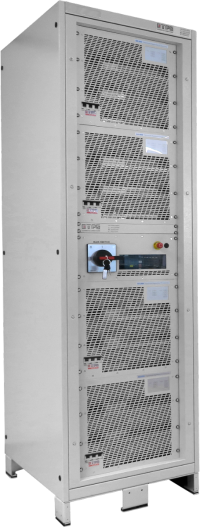
Over 70 years of development time has been invested to ensure the G5 series meets the foreseeable needs of research organisations. The modern Si-C range of DC power systems includes the G5-RSS (bidirectional sink/source), G5-SOURCE (DC power supply) and G5-REGEN variants (DC load). 
Units have industry leading response times, with current steps <50µs. Perfect for powering devices likely to experience transients, such as high speed drives. The ultra-fast dynamics with switchable capacitance allows for accurate simulation of energy storage devices 

Modules are available with nominals from 9kW to 54kW, at 60V to 1500V. Up to 120 units can be arranged in master/slave configurations. Outputs up to 3000V are possible into the megawatt range. Multi-module systems based around a mid-point earth create a +/- voltage output.

In addition to the Aurora interface, each G5-RSS is built with an isolated analogue interface as standard, with user configurable pins. The interface will support real-time control at the full 48kHz sampling rate of the system.

Along with setting (V/I/W/Ri) the analogue interface can be used to measure key parameters (V/I/W). The analogue interface can be used to externally log key values such as voltage, current and power no matter which other interface is active. For proportional setting and measurement, a 0-5V or 0-10V range can be selected. For example, a +10V signal when used to set current limit would mean that +162A would be set for a single 54kW/1000V/162A module.     

The analogue functions are provided via a SUB-D 25 pin female connector located on the rear panel of the G5-RSS module. Reference voltage (+10V and +24V) are provided for the proportional signals and digital high/low functions such as Voltage ON/OFF.

EAC-ACS-4Q Four Quadrant Amplifiers

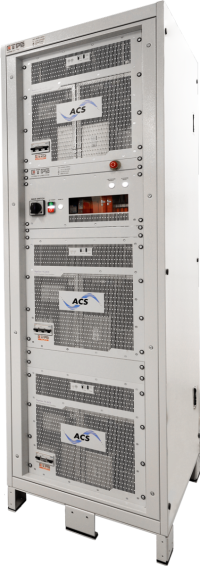
The EAC-ACS-4Q is a four quadrant AC/DC power system. Each unit can sink and source both AC and DC power. The module’s active neutral string allows for any single phase, split phase or asymmetric condition to be accurately simulated. Higher numbers of phases are possible when using multiple modules with a suitable P-HIL system, such as six phase or twelve phase systems.



The three phases of the EAC-ACS-4Q units can be controlled individually, allowing for almost any complex behaviour to be accurately emulated. All of the unit’s phases are individually programmable for voltage, frequency, phase angles and superimposed harmonics. Operation up to 1000Hz is possible at full power, with up to 5kHz possible at derated voltages and currents. Current control is also possible. Modules are available as 30kVA or 50kVA blocks, and are stackable up to 2.5MVA.

Besides the Aurora interface, BNC connectors are available to accept a -10V to +10V analogue signal, which is directly translated to an output voltage of -432V to +432V with a sampling rate of 80kHz and a typical delay of <70µs.

The module receives external signals via an analogue input for each phase. To achieve a desired output on the loadside of the module, the signals can be either amplified or reduced by a user defined scaling factor. For example, a 10V input is equal to 305Vrms (L-N). So if you want a maximum output of 152.5Vrms, then a factor of 0.5 (152.5/305) is entered into the scaling field.

For applications where you need to actively control the output current of the EAC-ACS-4Q, an additional current controlled amplifier mode is also available.

Accreditations

Added to Quote Cart

Your quote cart is currently empty.