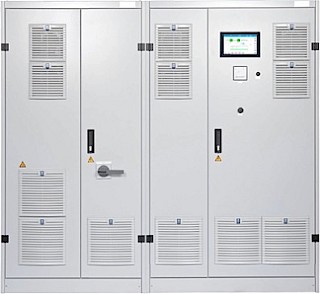
To investigate arc fault behaviour, a University of Manchester team needed a flexible power system to bridge the gap between research and application.
 When designing robust aircraft safety systems, electrical arcing needs to be considered as an inevitability. Common causes include mechanical wear and insulation failure. Arcing is hard to detect, generates intense heat and can damage wiring or nearby structures.
As aerospace transitions toward more‑electric architectures at higher voltages, the danger posed by arcing increases. Understanding arc characteristics and propagation will support the development of effective detection methods, improving aircraft safety.
During their final year research, a team of six MEng students developed a test rig to generate arcs in controlled conditions. An atmospheric chamber was used to produce low pressure environments, replicating altitudes up to 60,000 feet.
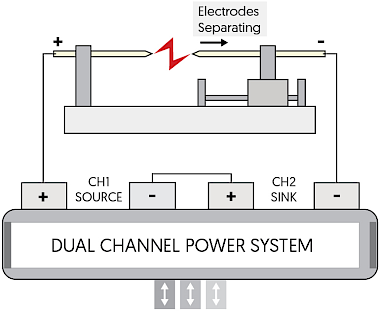 A voltage is applied to a pair of electrodes that are initially touching. As they gradually separate, an arc forms. The characteristics of this arc are monitored and recorded.
Traditional test set-ups consist of a separate power supply and resistive load. ETPS supplied a dual channel bidirectional DC power system to the group, with single point of control.
Professor Ian Cotton, stated “Two independently programmable channels allow one unit to emulate source resistance and constant power load characteristics simultaneously.”
“DC converters typically operate as constant power loads. As an arc develops, the voltage and current consumed by the ETPS power system vary in real time, emulating what would happen on the aircraft.”
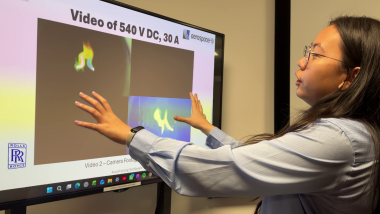 The students are supported by industry specialists from aerospaceHV and Rolls‑Royce. Sofia Mavidou, UTC Coordinator and Engineer at Rolls-Royce, explained “Delivering safe products is imperative to us. Investigating different arc fault scenarios is essential for effective mitigation. The team at the University is providing extremely valuable data.”